|
Everything we know about our prehistoric ancestors is that they were lean. Everything we know about our biology today is that to be overweight is unhealthy.
For our ancestors, food bonanzas were rare. Most of the time they were slightly hungry. We can imagine why. Getting food required work. They did the minimum work necessary for survival. If they finished lunch hungry, they had a choice. Go off for an hour or two and find more food or have a siesta during the heat of the day. There was thus an automatic mechanism controlling the intake of food. You had to really want the food to go to the effort of getting it.
Humans, unlike some creatures, were not living surrounded by their food. We do not have a well developed satiety reflex. That is to say, our bodies do not have strong signals telling us to stop eating. That never had to be programmed in to us in our Pleistocene past. On the contrary, we have a reflex that tells us to keep eating for as long as there is food around.
|
Human’s reflex is to keep eating food while the opportunity is there. |
Today of course, in the affluent countries, we are surrounded by food. We can, with no effort, satisfy our desire for food. Today, we have to exercise self-discipline. Fortunately that self discipline can be exercised not so much on the amount we eat but on what we eat.
How much weight is excess? There is a rule of thumb known as the Body Mass Index (BMI). It is calculated as your weight (in kg) divided by your height (in metres) squared. The same figures apply to both men and women.
Really lean hunter/gatherer societies like the Australian Aborigines or the Bushmen of the Kalahari have BMI’s in the range 13 to 19. These peoples have low blood pressure, no heart disease or diabetes, and no cancer.
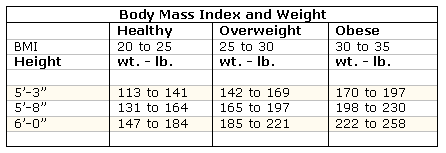
This seemingly is the ideal. An ideal that is hopelessly out of reach of the average Westerner. Fortunately it is not necessary to reach these very low figures for BMI. The studies show, and modern medical wisdom has accepted, that BMI’s in the range 20 to 25 are fine for optimum health. BMI’s of 25 to 30 are ‘overweight’, and already adverse health consequences are setting in. 30 to 35 is ‘obese’, Over 35 is ‘grossly obese’. As the level of overweight increases, so the health consequences become more desperate.
This table gives some typical values of BMI. The full range is given in the Natural Eating Manual.
What can be done about being overweight? Live like an Australian Aborigine! All right, in the real world that is not possible, so what are the strategies that we can deploy?
‘Fat makes you fat’. That is true, but that is not the whole story. If it were, Americans, who are paranoid about fat, would be the slimmest nation on earth. Instead, in spite of the 20-year drive against fat in the diet, Americans are fatter than ever! No, there are many other factors too. For example there is the factor of bad food combinations. Find out about these in the Natural Eating system and discover how to use this powerful tool to control weight.
In summary, focus your efforts on eating in accordance with the Natural Eating precepts. Don’t worry about how much you are eating. When you unlock your weight loss hormones, as becomes invevitable when dietary errors are eliminated, your excess weight will just slide off without cravings or real effort.
Underweight
We at Natural Eating have also been approached by people who need to increase weight. This is a much rarer condition! Nevertheless, people who are dysfunctionally underweight, rapidly find that this condition is corrected, simply by eating in the way Humans as a species are designed to eat – that is, Natural Eating.
It is a case of unlocking muscle-building and bone building hormones. You only have to ‘Eat Naturally’ and your weight will automatically adjust itself to the optimum weight for your metabolism, height and build.
|