|
Nutritional Anthropology The
Bond Effect |
|||
 |
DEADLY
HARVEST Between Our Health & Our Food GEOFF BOND |
Geoff Bond's |
|
|
The most recent Newsletters are available by private subscription Now Buy the
Nutritional Anthropology's Bible: by Geoff Bond
Healthy Harvest Information Page
|
Chapter 1 Much of what we think we know about food has filtered into our minds through our upbringing, our cultural conditioning, and commercial advertising. We absorb still other ideas from the not-so-subtle influences of the health industry, junk science, and the trendy wisdom of the day. Our individual theories are all different and no one could argue that any of them is the complete answer. The reason is simple—even the experts cannot agree. They are like the blindfolded men trying to guess that they are touching an elephant. One touches the trunk and thinks it is a snake, the next touches a leg and thinks it is a tree, and so on. There is, however, a valid science that has emerged which lifts the blindfold and shows the whole picture. It sees across the barriers between many compartmentalized scientific disciplines and finds new, overarching knowledge in the patterns that are revealed. We sometimes forget that, just like all other creatures on this planet, we sleep, feed, excrete, beget offspring, and indeed bleed. If we are like animals in those respects, then we resemble them in the rest. This new science studies how humans fit into this vast and complex
mosaic of nature. We go back to our origins to understand our place in
the scheme of things. We learn what it means to be human—as organic
beings—interacting in a multitude of intricate ways with our native
environment. Second, it uses a range of scientific disciplines to
identify the kind of feeding pattern for which our bodies have evolved
over millennia. We learn the kinds and proportions of plants and
creatures we consumed, and we match this with what we know makes us ill
or well today. Various peoples around the world practice a range of
dietary patterns—these practices are not without consequences and we
learn from those as well. This science puts all of these clues together to identify the ideal feeding pattern for the human species. Why is this important? Very simply, we are making ourselves grievously sick and unnaturally shortening our lives by blindly ignoring our nutritional heritage. This new science lights our way to the remedy: it not only gives us the definitive specification for the human diet, it also teaches us how to put it into practice. It is comforting to know that this is not only possible but also easy, once we connect the dots. Page 5 Above Page 6 Below What is this science? It links the study of human beings (anthropology) with the science of fueling the body (nutrition). That science is nutritional anthropology. It goes right to the heart of what it means to be a human being in nutritional terms. THE “OWNER’S MANUAL” FOR THE HUMAN BODY
• We will find tribes that, even in modern times, continue to live like our early ancestors. • We will analyze fossilized bones to see what food nutrients contributed to their structure and we will examine fossilized teeth to see what kind of feeding pattern caused them to wear and scratch in a particular way. • We will seek confirmation for what we discover by comparing our digestive system with other human-like creatures. OUR ANCESTRAL HOMELAND The great explorations of the 15th to 18th centuries found human beings living on every continent, with the
exception of Antarctica. Human populations were living in a huge variety
of climates, geographies, and cultures. In the 19th century, intrepid explorers discovered the chimpanzee and the
gorilla in the jungles of tropical Africa. Their human-like form and
eerily human behavior fascinated the people of the time. The great
naturalist Charles Darwin (1809–1882) predicted, but could not prove,
that humans (Homo sapiens) had their origins in tropical
Africa too. No one had yet uncovered any ancient fossils in Africa to
confirm this prediction. Page
6 Above Page
7 Below Then, in relatively quick succession, anthropologists discovered
ancient bones not in Africa, but in Germany in 1856 (Neanderthal), in
Indonesia in 1891 (Java Man), and in China in the 1930s (Peking Man).
They were all remains of humanlike species dating back 50,000 to one
million years ago. These creatures had stone tools, made rudimentary
ornaments, and daubed crude cave paintings. However, there was no center—these humanlike creatures seemed to
be living all over Europe and Asia. The picture was further confused because, in southern Europe about
30,000 years ago, there was an abrupt improvement in the sophistication
of tools and cave paintings. A new type of human, dubbed
“Cro-Magnon,” appeared on the scene. There was puzzlement about what
it all meant. Finally, in the 1960s, the anthropologists Louis and Mary Leakey
(and later their son, Richard) began uncovering extremely old, humanlike
bones in tropical East Africa (Kenya and Tanzania). Some of these bones
were several million years old. Two famous skeletons are “Turkana
boy” and “Lucy.” Once again, it was looking as though humans had
their origins in Africa after all. Remarkable Insights From DNA Allan Wilson and Rebecca Cann are Berkeley genetic microbiologists
who have used sophisticated DNA analysis techniques to trace the
ancestry of humans back to their origins [1]. They and other pioneering researchers, such as the geneticist L.
Luca Cavalli-Sforza, [2]
have built up a remarkably precise picture of our ancient
genealogy. The molecular evidence indicates that Homo sapiens arose around 250,000 years ago.
The population of Homo sapiens was small—no more than about 10,000 of them—and the population
remained at around this level for a very long time. Furthermore, studies
of the genes of different peoples from all over the world show that all
their ancestral lines lead back to a single location for our homeland.
This key information tells us that our mother country is an area bounded
by Kenya, Tanzania, and Ethiopia. Indeed, these studies show that our ancestors remained in their
homeland until about 60,000 years ago. According to the eminent
Anglo-American anthropologist Ian Tattersall, we now know that everyone
on this planet is descended Page
7 Above Page
8 Below We can now piece together what happened. Over a period of a million
years, successive waves of humanlike creatures overflowed out of Africa
to populate most of the Old World. They had brains about half the size
of ours, but walked upright and had many humanlike traits. They have
been broadly called Homo
erectus, of which the Neanderthals were just one branch. Then, about 250,000
years ago, a radical thing happened: a new breed of Homo erectus arose in East Africa, our own
ancestor, Homo sapiens. Homo sapiens were brainier, more agile, more inventive, but more lightly built
than Homo erectus. They were successful in their ability to survive and to multiply.
However, to feed themselves, they needed around 100 square miles of
living space per band of 50 people. So, in their turn, about 60,000
years ago, they overflowed out of Africa into Asia. How Humans Migrated Around the World On the one hand, those areas that are rich in game and vegetation
could support a relatively dense population of up to 50 people per 25
square miles. On the other hand, the early European settlers thought,
wrongly, that the deserts The Human Timeline I will refer to this formative era frequently
throughout the book, so I will give it a specific name. Geologists
have a convenient, often-used epoch for this approximate time
period—the Pleistocene, which runs from 1,600,000 years ago to
10,000 years ago. However, I want to conclude the formative era
earlier, at about 60,000 years ago. Since our ancestors spent this
time entirely in Africa, I will call this critical formative era the
“African Pleistocene.”
Page
9 Below and ‘outback’ were empty. Even they were
populated, but at lower densities— down as far as 50 people per 300
square miles. The total Aboriginal population of the Australian continent (about
the same area as the continental United States) stabilized at around
800,000 people. The population density is said to have reached
“saturation.” These densities are, of course, much lower than we are
used to seeing in the industrialized West today. The U.S. supports 280
million people, an average density of 50 people on only 480 acres, or
three-quarters of a square mile. About 35,000 years ago, Homo sapiens was knocking at the doors of Europe. Here they found
themselves in stiff competition with the Neanderthals. John Kappelman,
an anthropologist who has written about the biology of ancient,
humanlike creatures, reports that the Neanderthals were massive, at
least 30% larger than the ordinary human today [4]. They had the heavily muscled body and stature of an Olympic
wrestler and weighed up to 200 pounds (91 kg). On the other hand, their
brains were somewhat smaller than modern man’s is today. We will never know exactly what happened to the Neanderthals.
However, every human male was a potent “Jack-the-Giant-Killer:” he
was smarter, wilier, and more organized than the more powerful, yet
dim-witted, giant of the forest. Over several thousand years, it is
probable that he killed them all off. That is what happens when
too-similar species compete for the same living space. By 30,000 years ago, the Neanderthals had gone and the Homo sapiens newcomers had introduced their
own, developing culture. This explains the quantum leap in art and
technology of the time. These new people were the Cro-Magnons, the
ancestors of Europeans. Meanwhile, in the Middle East, India, China, and
Siberia, other Homo sapiens similar to the Cro-Magnons
drove all the other branches of Homo erectus into extinction. By 20,000 years ago, humans had
fanned out over the whole of the Old World. About 15,000 years ago, toward the end of the last ice age, sea
levels were still low and it was possible to canoe or walk from Siberia,
across the Bering Strait to what is now Alaska. Finally, the first few
humans broke out of the Old World and penetrated into the Americas.
There they found a New World rich in plants and game, empty of humans,
and free of competition, and they prospered well. As they multiplied, their frontier advanced south. The swelling
population spread, at an average rate of 8 miles per year, through
territories that now include Canada, the United States, Mexico, and
Central and South America, right down to Patagonia. By about 10,000
years ago, the Americas were peopled ‘to saturation’ for their
ancestral lifestyle. We must remember that ‘saturation’ is still a
very low density by modern standards: an average of 100 square miles of
living space per band of 50 people. These first, pioneering peoples
became the indigenous Indian tribes or “Amerindians.” The essential idea to retain about our past is this: that we are
all still tropical creatures who only left our homeland 2,000
generations (60,000 years) ago. Page
9 Above Page
10 Below
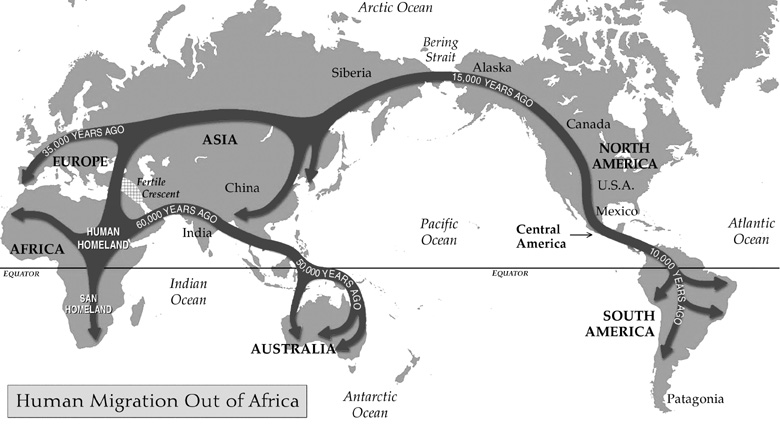
Human
Migration Out of Africa This map of the world shows the broad migration pattern of our
human ancestors as they overflowed out of their “Human Homeland” in
east Africa. Note that we are just showing the overall pattern and
timings, not the detailed wanderings and itineraries. The earliest wave
of migrants, 60,000 years ago, went via India and Indonesia to
Australia. Later migrations arrived in Asia and in Europe. Finally
humans crossed from Asia into North America and penetrated all the way
down to the southern tip of South America. Meanwhile, other groups had
already spread into the other parts of Africa itself. We show the
location of one of these groups, the San Bushman, whom we talk about in
some detail later in this chapter. We also show an area known as the
Fertile Crescent, which we discuss in Chapter 2. Pages 11 & 12 Above Page
12
Below While 2,000 generations might seem like a lot, it is just an
eye-blink in evolutionary terms. The bacteria in our guts go through
that many generations in the space of two months. We do not expect a
species to change much, if at all, in such a short space of time. We
know that our bodies are still the same, we have the same biochemistry,
and we have the same digestive arrangements. We look a little different on the outside, of course. Over the last
2,000 generations, superficial racial differences have evolved, but
underneath we are all still the same. We all have a common recent
origin. In other words, everyone on this planet still inhabits a body
designed for life in our ancestral homeland, the tropical, east African
savanna. The DNA evidence is a ringing endorsement of the Leakeys’
fossil evidence. The cradle of mankind is in the African Rift Valley
stretching from Olduvai in northern Tanzania, all the way through Kenya
to Lake Turkana in southern Ethiopia. What was Our Homeland Like? If we conjure up a picture of the African savanna landscape, it is
the classic image of open, rolling grassland with the occasional tree,
bush, and shrub. In the wetter areas, there are thickets and groves of
beautiful flowering shrubs and trees. In parts, termite mounds stand up
to 25 feet (8 meters) high. The floor of the African Rift Valley is not
very high above sea level, but there are nearby plateaus; some mountains
rise to over 10,000 feet (3,000 meters). There are several large, and
many small, lakes, many waterholes, and some streams and rivers. The weather fluctuates between mild and hot for most parts of the
year, about 55°F to 90°F (13°C to 32°C). There are rainy and dry
seasons. Annual rainfall is moderate: between 35 inches (900 mm) and 60
inches (1,500 mm), and the rain comes in unpredictable storms and
showers.
How
Long is a Human Generation? A human generation can only be approximated and we
have to work with averages.
Conventionally, many scientists “assume” that a
generation is 25 years, which is a suspiciously round and convenient
number. As we shall see, in our hunter gatherer past, women bore
children from about 20 years old to about 46 years old. The mid-point
is therefore around 33 years. If we allow for some tapering of
fecundity with age, it is likely that the average age of a generation
for most of human history is around 30 years. This is the figure we
have used.
Page
13 Below Our ancestors were not alone in the savanna. They shared the land
with a wide variety of creatures: giraffe, lion, elephant, warthog,
rhinoceros, hyena, antelope, gazelle, zebra, baboons, chimpanzees,
vultures, eagles, flamingos, and many more. In addition, there were
snakes, porcupines, crocodiles, lizards, tortoises, snails,
grasshoppers, and a myriad of small mammals, reptiles, and insects. The
lakes, streams, and waterholes teemed with many species of freshwater
fish, shellfish, frogs, toads, ducks, geese, and other aquatic
creatures. Our ancient ancestors lived for countless generations in these
circumstances. This environment fashioned our bodies, our naturally
adapted lifestyle, and our mentality. With this sketch of it in mind, we
can discover how nature designed us to live in this environment. In
particular, we will focus on the kind of eating pattern that is right
for us. THE SAN BUSHMEN The San Bushmen (more correctly called by their own name, the
!Kung) at one time occupied a large part of southern Africa. Negroid
Bantu herders (Zulus and Xhosa) migrating from West Africa have pushed
them into a smaller, remote area—the Kalahari—over the past 600
years. The Kalahari is a sandy wilderness, well covered with trees,
scrub, vines, creepers, and grasses. The sand drains the rainfall fast,
so there is little surface water, just scattered waterholes. Animal life
is varied, and many species such as antelope, lion, giraffe, zebra, and
elephant thrive there. It is very like our ancestral homeland, but
without the streams and lakes. The San are short, slender, and fine-featured with a reddish-yellow
skin. Laurens van der Post describes the color as “Provençal
apricot” [5]. The San have tightly coiled, peppercorn colored, and woolly hair.
Their noses are broad, and they have pointy ears with no lobes. They
have high cheekbones and somewhat Mongoloid eyes. The Italian geneticist Ornella Semino and others have shown that
the San are southern Africa’s most ancient inhabitants [6]. In 60,000 years, they have
migrated only 1,500 miles from humanity’s homeland in the African Rift
Valley. The San live in groups of 40 to 60 people (about 6 to 10 families).
A typical group (or band) has about 15–20 men, 15–20 women, and a
further 15–20 Page
13
Above Page
14 Below dependent children. The group “owns” their
territory of some 125 square miles (320 km2) within which they roam. They camp for a few days in a place and
then move on. In the space of six months, one band was recorded by the
ethnic archaeologist John Yellen, as having moved 37 times, an average
of once every five days [7]. When they have exhausted the food supply of the area, they travel
to the next site, which can be up to 20 miles away. The San wear no clothes. They do not have any possessions beyond
what is easily portable and can be carried long distances. Babes-in-arms
are carried by their mothers, but everyone else has to walk. They
carefully choose the next campsite for the availability of plant and
animal food. Sometimes the whole group will move to the place where the
men have killed a large animal and then stay until the meat is all gone.
Game animals that come to waterholes are a rich source of food. To avoid
frightening them away, and in spite of the inconvenience, they camp at
least a quarter mile away from a waterhole. How the San Feed Themselves Women’s Work The Digging Stick and New Food Resources The women’s
digging stick gives humans a big advantage over their competitors in
the same ecological niche. Baboons, for example, often get to a
fruiting tree and strip it before the humans arrive, but baboons are
incapable of digging down to underground foods. The women have two types of activity: picking and digging. From
above ground, the women pick fruits, nuts, berries, flowers, gums,
stalks, pods, leaves, Page
14 Above Page
15 Below and all kinds of edible plant parts. From below ground, they poke
out, with their digging sticks, a whole variety of stems, bulbs, corms,
and roots. It is estimated that the San use over 100 species of plant as food, although many of them are tiresome to collect and not always agreeable to eat. Given the chance, they tend to concentrate on just 15 to 20 species that are reliable to find, tasty, and easy to gather. The most consumed species is the fruit and nutlike kernel of the mongongo tree. Groves of these trees are found all over San territory, and their edible parts are available for large parts of the year. The baobab fruit is another staple. It is delectable, rich in vitamin C, calcium, and magnesium. It too has a kernel that is nutlike. Raw, the tsin bean is slimy and inedible, but once roasted is an enjoyable delicacy [10]. John Yellen and Richard Lee
record the San as eating peanuts on a regular basis [11]. This demonstrates some of the
difficulties of reconstructing the ancestral diet. The peanut is native
to tropical South America and was introduced to Africa by European
explorers only around 400 years ago. Since then, it has spread so
rapidly that hunter-gatherers in the Kalahari desert can think of it as
a normal native food. However, we can be sure that our African
Pleistocene ancestors never ate peanuts. Green salad vegetables, such as scilla and talinum (a kind of
purslane), appear at the start of the rainy season. Fruits, such as the
!igwa, ochna, and grewia berries and the ivory fruit, yield hundreds of
pounds during their seasons. None of these fruits is sweet and many are
bitter. Most foods are highly fibrous. Jiro Tanaka estimates that the
San eat on average 2 pounds (900 g) of plant food per person per day. Plant foods are an important, even critical, source of water. One
of the most important is the bitter-juiced tsama melon, from which our
familiar (but sweet) watermelon is descended [12]. Indeed, the San obtain more than 90% of their water
needs from plants. This is not typical for our African Pleistocene
ancestors, who would have had access to waterholes, ponds, and streams
year round. It is fascinating to realize that the human body can survive
without free water at all, provided there is access to enough plant food
of the right type. The women also collect eggs of all kinds and capture small animals
such as locusts, caterpillars, grubs, toads, tortoises, and snakes.
Ostrich eggs are particularly valued. The contents supply a good portion
of food, the shells make containers for water, and bits of shell are
carved into beads. On their gathering trips, the women will note and report to the men
any signs of game that might be good to hunt. Both men and women live in
an intimate relationship with the natural world around them. They are
incredible botanists and can identify all the plants and know exactly
which ones are good to eat and what else each plant might be good for.
They are amazing naturalists— they live in close contact with animal
life and seem to know what it is like to be in the mind of the larger
mammals, such as elephants, lions, or antelopes. Page
15 Above Page
16 Below Men’s Work Most of the hunting is unspectacular. The men go after small
creatures using snares, traps, and guile. Commonly, the San hunt for
springhare, a type of large rodent that sleeps in its deep burrow during
the day. The hunter pokes a flexible, barb-tipped 20-foot pole down the
burrow until he has hooked the animal.He then digs the creature out.
Porcupines and 150-pound ‘antbears’ are smoked out, dug out, or even
speared by crawling down the burrow. Warthogs are run to death with
hunting dogs. A fire is lit at the entrance to the tunnel and then they
are speared as they try to escape. The warthog is highly prized for its
fatty flesh, a rarity in the San diet. Game birds like guinea fowl, francolin, and bustard are captured in
cunning snares. Ostrich is hunted on occasion. As mentioned earlier, the
San do not have much access to water, but when they get the chance, they
spear fish, trap toads, and collect shellfish. Big game, such as eland (a huge, ox-like antelope weighing up to
one ton), gemsbok, and wildebeest, are hunted as the occasion presents
itself. However, the effort required is enormous and the outcome
uncertain. In one incident, the San tracked a herd of eland for eight
days and finally shot one of them with poison arrows. They followed the
wounded eland for another three days before it collapsed and could be
killed and butchered. Giraffe are occasionally hunted, but not with much
success. How Important is Hunted Food?
Page 16 Above Page 17 Below Everything else is taken back to base and will be eaten. Blood is carried in bags made from the stomach or bladder. The hunters wring out the half-digested grasses in the paunch and drink the fluid to save precious water. Back at the camp, they dry surplus strips of the meat to a kind of pemmican. Even the hide is pounded up and eaten, or parts are kept to make leather artifacts as needed. Soft parts such as udders, fetus, heart, lung, brains, and blood are given to old people with worn down teeth. The intestines are emptied of their excrement, cleaned, and are much prized as a delicacy. Hooves and trotters are picked clean; gristle is dried and pounded. Sinews are used to make string. The major bones are eagerly cracked open for their fatty marrow; marrow fat is mainly of the monounsaturated kind. The conventional muscle meat is, of course, much desired. Nothing is wasted. Children eat what the adults eat. Babies and toddlers are breast-fed until they are about four years old. The mother introduces easily chewed, solid foods after the first teeth have broken through. The search for honey occupies an inordinate amount of effort, guile, and time. The reason is simple: it is just about the only source of sweetness in the San diet. When they find a bees’ nest (usually in a hole in a tree), they waft smoke from a smoldering bunch of specially selected herbs toward the bees. The bees think a forest fire is coming, gorge themselves on honey, and then flee the hive. In this state, they are both absent and docile. This is just as well: these insects are the fearsome African killer bees that make mass attacks and kill anything that gets in the way. When the coast is clear, the San puts his hand into the nest and scoops up a handful of comb, dripping with honey and flecked with half-developed grubs. This is shared out and eaten on the spot, wax, grubs, and all. The San try to leave enough intact comb so that the bees are not driven away permanently. That way they can come back from time to time and harvest more honey. The San are so possessive about this resource that ownership of the nest is passed on from father to son. From a nutritional point of view, the amount of honey is insignificant; they only get the equivalent of a candy bar three or four times a year. However, from a psychological point of view, this is a high point in the San life. The San Food Supply Page 17 Above Page 18 Below food [14]. The reason for the difference is that there are more calories per pound in animal foods than plant foods. The San can survive very well without hunted food at all. However, it is certain that they could not survive without the women’s gathered animal and plant food. The men’s work—hunting—is an optional extra. In spite of that, hunting preoccupies the thoughts of both men and women. It inspires songs, dances, storytelling, and interminable plotting and cogitation. Why this might be so, and why men are necessary, especially husbands, is discussed in Chapter 8. Richard Lee estimates that an adult San spends about 12 to 19 hours per week getting food [15]. That is the only “work” there is; after that, it is just lazing around, chatting, singing, dancing, making the odd piece of body adornment, and preparing hunting equipment. It is a very easy-going lifestyle. Compared to today’s average 40-hour work week, which does not include food shopping and preparation time, the San lifestyle was very leisurely. This is all very agreeable, but what is the effect of this lifestyle on the health of the San? The State of the San’s Health Body Mass Index The body mass index (BMI) is a useful rule of thumb to test whether you are a healthy weight for your height. Conventional medical wisdom considers a “healthy” BMI to lie between 18 and 25; “overweight” is 26 to 30; “obese” is 31 and over. Stuart Truswell and John Hansen are medical doctors who conducted nutritional and medical research on the San in the 1960s. They found that, predictably, the San do not suffer from diseases associated with obesity [17]. Diabetes is unknown. They have one of the lowest cholesterol levels in the world: total cholesterol levels for all age groups are around 120 mg/100 ml; phospholipids and triglycerides are low too. The diet is very low in fats of all kinds, and the types of fats are healthier.They are mainly polyunsaturated fats with very little saturated fat. It is interesting to compare the fats in the San’s blood with those in the average European’s blood. The San has a much higher percentage of the polyunsaturated omega-3 fat (26% to 9%) and a lower percentage of the polyunsaturated omega-6 fat (34% to 40%). This is not surprising: in contrast to Westerners, the San are eating a diet Page 18 Above Page
19 Below The Australian Aborigine Another example of a primal tribe, very remote from the San Bushman, is the Australian Aborigine, who lived a completely primal existence until European settlers first arrived in Australia 200 years ago. The continent of Australia has a wide variety of climates, ranging from tropical in the north to temperate in the south. The vast interior of Australia is very dry and much of it is desert. Remarkably, in spite of the wide variation of climate and geography, the Aboriginal living arrangements hardly differed from the Bushman. They lived in bands of 30 to 50 people, men, women, and children included [24]. Each group circulated in its territory, which could have an area of up to 300 square miles in barren regions. They were constantly on the move, camping for a few days and then moving on 10 to 15 miles to the next campsite. How the Aborigines Feed Themselves The basic food collecting patterns were similar to the San’s, especially in the savanna areas that mirror our African homeland [25]. The women gathered and the men hunted. The women used digging sticks and collected plants, insects, and small animals, providing the base load of food on a daily basis. The kinds of plants collected were quite different species to those of the Kalahari, but had very similar characteristics: young leaves and shoots, roots, tubers, bulbs, fibrous fruits, nuts, gums, flowers, water lily roots, and berries. The animal food collected would be eggs, turtles,
snakes, shellfish, crabs, caterpillars (e.g., the witchety grub and
the bogong moth), land snails, and the goanna (a giant lizard). Sweet
foods were very rare but much prized. Disproportionate amounts of time
were spent on finding a bees’ nest to smoke out. Other sweetmeats
were the honey ant, gorged with nectar, and “lerp,” a sweet insect
secretion on eucalyptus leaves. In times of scarcity, grass seeds were
collected, winnowed, and ground between two handheld stones [26]. The
drudgery of this task was viewed with such distaste that it was only
done very rarely. The men would spend a lot of thought, ingenuity, and time on the hunt, which was often unsuccessful. Stories about the hunts, past, present, and future dominated their conversations. Unlike the San, the Aboriginal did not have the bow and arrow—they still used spears, traps, snares, boomerangs, and fire. They hunted and trapped wallaby, kangaroo, freshwater fish, snakes, platypus, possums, birds, ducks, and emu. The Aboriginal Food Supply Page 20 Below was very low in fat (less than 3%) [27]. It was
mainly polyunsaturated fat, and there was little saturated fat. The
polyunsaturated fat was composed of equal percentages from the omega-3
and omega-6 families. As with the Bushman, fat was much sought after:
fatty parts of the carcass were prized, distributed with ceremony, and
eaten with relish. The witchety grub was rich in monounsaturated fat,
similar to olive oil. The Aborigine ate most plant food raw, but if it tasted better roasted, some was tossed into the embers of a fire. Animal food was mostly cooked. Small game, snakes, lizards, and grubs would be baked in the embers. Larger animals would be gutted and the variety meats (offal) cooked and eaten separately; the carcass would be baked whole. The State of the Aborigine’s Health At the time of European settlement 200 years ago, the Aboriginal was described as being in good health and of athletic physique. In the 1960s, researchers studied Aboriginals still living the traditional way and found that they were incredibly lean by our standards, with body mass indexes ranging from 16 to 20 [28]. They also had low blood pressure, low cholesterol, and no atherosclerosis or diabetes. Their blood samples showed high levels of hemoglobin, vitamins C and B12, folate, and a good sodium/potassium ratio. However, the Aborigines’ health disintegrates when they adopt a European lifestyle. that contains roughly equal amounts of omega-3 and omega-6 fats.
The main sources of fats for the San are nuts and wild creatures, both
of which have very different fatty acid profiles to the foods habitually
consumed in the West. In addition, their bodies are not fabricating fats
out of the kinds of food that are making Westerners fat. There is no sign of coronary heart disease, atherosclerosis, or thrombosis. Researchers have found no case of varicose veins, piles, or hernias. No cases of cancer or osteoporosis were seen either. Average blood pressure is a low 120/75 and it does not increase with age; not a single case was found of high blood pressure. In 1966, the South African ear, nose, and throat specialists John
Jarvis and H.G. van Heerden made hearing tests on 10 old Bushmen and
found that they had perfect hearing [18]. There was little or no earwax and the drum could be easily seen.
Teeth were also free of caries (cavities). In old age, eyesight still
remained excellent for distance, but, in a few, the lens has lost some
transparency. Other researchers found that the San received healthy levels of
vitamins A, B12, C, and D, folate, thiamine, riboflavin, niacin, iron, calcium,
iodine, zinc, copper, and other trace elements [19]. The human body is designed to manufacture vitamin D
from sunlight. The San, like our African Pleistocene ancestors, lived in
a sunny place and spent all day outdoors, with no clothes on. Their
bodies manufactured Page
20 Above Page
21 Below all the vitamin D they needed. Nobody suffered from
anemia or protein deficiency. The kidneys were functioning normally on
the low-salt diet and were excreting very little salt in the urine.
Levels of phosphorus in the urine were very low. Lactose is a type of sugar found uniquely in milk. It is an
aggressive allergen for most adults, although some Caucasians can put up
with it. The San, in common with most peoples of the world, are
uniformly intolerant of lactose. In glucose tolerance tests, the San had
responses that are within the normal, non-diabetic range. Insulin
response was slow, as is normal for humans who have virtually no sugars
in the diet. The San are in excellent health by any terms, let alone under the arduous conditions in which they live. Their old people live to a venerable yet healthy old age, in good shape right to the end. The “end” comes when they are too old to walk the 10 or so miles to the next campsite. The aged San makes contact with the spirits of his waiting ancestors. He is propped up under a bush with a supply of water, food, and weapons; he is surrounded with a thicket of thorny branches to keep the predators away. Sorrowful goodbyes are said and the band moves on. That is how it has always been, and there is nothing else to be done. After a day or two, the carnivores will snout the thorns aside and close in. A Potent Lesson
FOSSIL EVIDENCE
Page
21 Above Page
22 Below However, there is more to bones than just the marks on them. A
person builds bones from the foods that he or she eats, so it is
possible to analyze the chemical composition of a bone to find out the
foods eaten to make that bone. Michael Richards, a specialist in
prehistoric diets from the University of Bradford, finds that, 30,000
years ago, the Cro-Magnons of Europe ate fish, turtles, shellfish, and
birds [22]. Meanwhile the Neanderthals, who lived alongside
them, ate reindeer, mammoth, and other large herbivores. Ancient teeth are another rich source of information. Have you ever
wondered why your back teeth have those difficult-to-clean biting
surfaces? Dental researchers like Peter Lucas and W. Maier studied what
is so special about these shapes. They find that they are best for
grinding up plant food; on the other hand, they are not very good for
meat or seeds [23]. Other researchers have examined
the tooth enamel and find that the thickness and strength of human
enamel is designed for a plant food diet that is halfway between that of
a chimpanzee and a gorilla [29]. A chimpanzee eats mostly soft plant foods like fruits and tender
leaves, while a gorilla eats tough leaves and even twigs and branches. Yet other researchers look at the scratches and wear on ancient
teeth. The Spanish biologist Carles Lalueza and others find that
Neanderthals have tooth wear typical of a meat diet [30]. In contrast, the teeth of African Pleistocene humans
show that they were eating an abrasive, high plant food diet. Remarkably, fossilized excrement, known as coprolite, has been
discovered and is a good source of information. Michael Kliks, a
specialist in intestinal health, has studied ancient coprolites and
reports that, until quite recently, human populations took in impressive
amounts of plant fiber—around 130 grams per day [31]. Fascinatingly, also in the fossilized excrement, he found
undigested residues of bones, teeth, hair, feathers, fish scales, and
insect shells. CIRCUMSTANTIAL OR INDIRECT EVIDENCE
The Path of Least Work Page
22 Above Page
23 Below emerges very strongly is that humans are economical with their energy. They seem to have a calculator in their heads, whirring away, working out what is the best return for the effort they spend. This is known as finding “the path of least work” to get what they want. (No surprises there!) In terms of finding food, this is known as “optimal foraging” strategy. Very simply, how does a human being efficiently find food in the African savanna with only bare hands, a pointed stick, and loads of ingenuity? Several studies have examined the effort compared to the benefit for various feeding patterns. Not surprisingly, they find that, overall, it requires the least effort to collect foodstuffs that stay still or only move very slowly. Therefore, plants of all kinds, eggs, and slow-moving animals provide the vast bulk of the diet. In addition, foods that require little or no processing are given top priority. As we saw, the Aboriginal only ate grass seed as a last resort; it was just too time-consuming and tedious. These optimal foraging analyses all reinforce our picture of the true eating pattern practiced by the San and Aboriginal. However, it begs the question why humans bothered with hunting at all: it is dangerous, it requires lots of energy, and the results are uncertain. Worse, the hunter, instead of finding dinner, could become dinner! The answer to this fascinating question is explored in Chapter 8. What Kind of Food is Our Digestive System Designed For? The closest relatives to humans in the evolutionary tree are the chimpanzee and the gorilla. Since we share the same lineage, we can expect to share similar, if not identical, eating habits too. At the very least, our digestive systems will share a common heritage, even if they have been pressed into slightly different uses since our ancestral lines diverged. Several groundbreaking studies, including those by the geneticists Charles Sibley, [32] Jeffrey Rogers, [33] and Morris Goodman [34] show that the chimpanzee and the gorilla share over 98% of their DNA with human DNA. Their body plan is almost the same as each other’s and ours. The gorilla is what is known as a vegan, a creature that consumes no food of animal origin whatever. A male gorilla is a gentle giant weighing 450 pounds of solid bone and muscle. He can climb trees with ease and swing his great weight through the branches. Even so, to keep his body supplied, he needs to eat 50 pounds of vegetation per day. His diet is chiefly leaves, fruit, and even small twigs and bark. He can spend up to eight hours eating. Vegetation is not
Page 24 Below rich in calories, so the gorilla has to economize energy expenditure—he is a slow, deliberate mover. Chimpanzees are rather smaller than the average human and they are much more active than the gorilla. They, too, have a diet that is focused on plant food, but more oriented to ripe fruit and young leaves. In addition, they kill and eat small creatures, particularly monkeys and small wild pigs. Some chimpanzees even poke a stick into a termite nest and eat the termites that crawl out. It is estimated that around 6% of the chimpanzee’s calories are of animal origin. Humans, gorillas, and chimpanzees share an ancestral line that goes back to fruit-eating creatures. Over the millennia, their eating pattern has diverged somewhat, but the same digestive system is pressed into service. All humanlike creatures share the same basic pattern. As anthropologist Katharine Milton observes, they have a simple stomach, a lengthy small intestine, a modest-sized cecum, and a corrugated colon [35]. The cecum is the first region of the colon. It has a deep layer of muscle that kneads the contents and propels them forward. In contrast to the human cecum, the carnivore cecum is much smaller. There are other differences too: in the cat and dog, muscle contractions of the cecum are much more vigorous and they can reverse direction, sending the contents back up into the intestine. Humanlike creatures also have an appendix. This is an unusual structure and contrary to popular belief, it serves a useful purpose. It secretes digestive helpers such as mucin, eripsin, and amylase; the appendix is also a powerful producer of antibodies for the immune system. The only other type of creature that has an appendix is leaf-eating animals (folivores), notably the rabbit and the capybara (a large, vegetarian, South American, semi-aquatic creature related to the guinea pig). Surprisingly, it is difficult to be precise about the true dimensions of a digestive system. The various components are particularly elastic and the proportions can vary significantly from one individual to another. According to an individual’s eating habits, the stomach is contracted or bloated; the colon longer or shorter. Indeed, a baby’s colon has proportions similar to those of other apes. As humans mature, their colon, relatively speaking, shortens [36]. But this may only happen to Westerners on a low-fiber diet. It is suggestive that in other apes, the opposite happens—their colons get longer with age. It would be surprising if ours were not intended to do the same. Gorillas have long colons anyway compared to humans. This is where they digest their large intake of plant material. However, we can learn even more from the curious fact that our digestive system is even closer in design to that of the capuchin monkey. Capuchins are little, stocky, nimble creatures that live in Central America. Like humans, capuchins have a small intestine that is lengthy compared to the colon. The overall length of gut (small intestine plus colon) compared to body size is also small compared to other apes and monkeys. This indicates that humans are designed for a similar type of food supply. Capuchins eat a high-quality diet made up of Page 24 Above Page 22 Below unusually rich wild foods, both fruits and oil-rich nuts. They also spend a disproportionate amount of time seeking out animal matter, including grubs, grasshoppers, and small animals. Similarly, savanna baboons painstakingly seek out small nutritious food items—up to 3,000 in a day, including gums, flowers, fruits, and small animals and insects. Neither the baboon nor the capuchin monkey is as close to us genetically as the great apes. However, they have feeding environments that are more similar to the human one and they evolved digestive systems that have a similar design to ours. What Kinds of Foods are Our Bodies Designed to Capture Chimpanzees and baboons use their hands a great deal to prepare their food. It is no coincidence that the same hand, with its ability to grasp an object, is also one that is good for grasping a branch. Like us, these creatures show great dexterity: they will pick out the choice part of a plant or unwrap a leaf to find a grub inside. LIVING THE WAY NATURE INTENDED We have built up a picture of the lifestyle experienced by our ancestors for hundreds of thousands of years. We have identified the kinds of feeding opportunities they had and described the use that they made of their environment, including their behavior within it. We know that even today, our digestive systems, biochemistry, brains, psychology, and bodies are still those designed for life in the savanna of East Africa. I call this lifestyle the “Savanna Model.” We have not yet done any interpreting or drawn any conclusions, which will come later as we piece together yet more evidence. However, already we can discern the major outlines of our Owner’s Manual. Our African Pleistocene ancestors had a food supply in which plant material was a major component and animal matter was a moderate component. We have seen that the types of plants and animal matter were quite different from what we consume today. We will discover that these differences are of capital importance. Their diet contained certain Page 25 above Page 26 below types of fat but not others. What they did not eat is of equal importance: we eat many groups of food today that did not form part of our ancestral diet. Contrary to modern myth, those far-off ancestors lived long, healthy lives. In so many fundamental ways, our modern lives have diverged from the lifestyle that Nature intended. It is estimated that the average Westerner loses 10 to 15 years of life thanks to dysfunctional eating habits. Furthermore, those extra years would be lived in great physical shape to the end. This ancestral lifestyle seems exotic—far removed from how we live today—and few would like to return to it. Indeed, population densities are now so high that there just is not enough space to go around. So, we are stuck with what we have got; there is no going back. However, the good news is that we can work intelligently to get the best of both worlds, ancient and modern. In the next chapter, we look at the distortions that have occurred in human dietary patterns worldwide since that far-off time. We will see what impact these distortions have on our health and well-being, and we will use these insights to write more segments of the Owner’s Manual. |
||
| On to Chapter Two | |||